


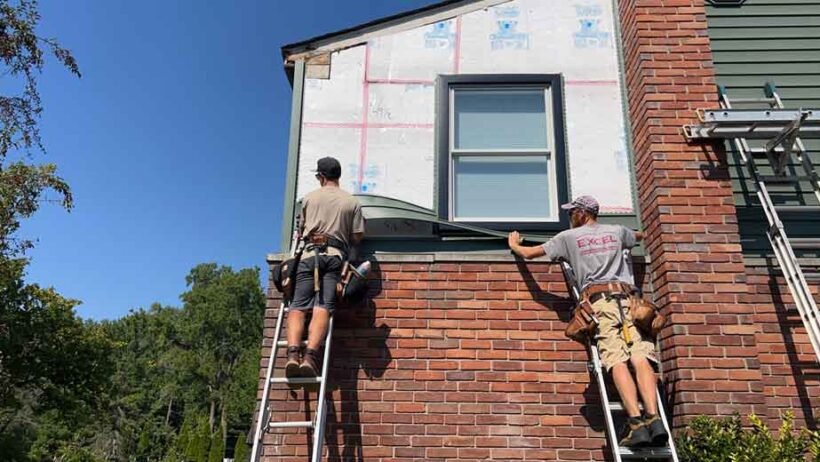

Siding does a lot more than change the look of your home. It is the outer layer that takes the daily beating from wind, sun, and wind-driven rain, then helps your wall assembly dry back out again. In a place like Southwestern Ontario, where weather can swing quickly and annual precipitation sits around 1,011.5 mm on average, the “how” of installation matters just as much as the material you choose.
If you want a clear picture of what the process should include, this page on Professional Siding Installation in London Ontario is a useful reference point for understanding the workflow and what questions to ask during planning.
Think of siding as a system, not a layer
A common misconception is that siding is the waterproof shield. In reality, most siding systems are designed to shed most water, but not necessarily all of it. The wall behind the siding is what manages the “what if” moments: wind pushes rain sideways, ice builds up, caulking ages, or a seam gets stressed during freeze-thaw.
Modern best practice leans toward a “rain management” mindset: deflect what you can, drain what gets through, and make sure the wall can dry. That general approach is echoed in Ontario-focused guidance on rain penetration control for exterior walls.
Before the first panel goes up: prep that protects your home (and your sanity)
A clean install starts before removal day. Homeowners can make a huge difference with a little planning:
- Confirm what’s staying and what’s changing.New siding often touches trim, light fixtures, hose bibs, vents, meter bases, and exterior outlets. Decide early what needs new mounting blocks or extensions.
- Clear the work zone.Expect ladders, debris, and lots of up-and-down movement. Move planters, patio furniture, and anything fragile at least a couple of metres back.
- Protect landscaping intentionally.You do not need to strip your yard bare, but you do want a clear perimeter and a plan for delicate shrubs. The best crews will protect plants, but access is still everything.
- Discuss noise, parking, and disposal.Tear-off is loud and messy for a short window. Make sure there’s a plan for bins, driveway space, and cleanup expectations.
This is also the right moment to ask how your installer handles surprises, because almost every siding project reveals something once the old layer comes off.
Tear-off and inspection: where expensive problems get caught early
Removal is not just demolition. It is the inspection window you rarely get any other way. A quality crew will slow down long enough to check:
- Sheathing condition:swelling, rot, delamination, or soft spots
- Flashing failures:especially above windows, doors, and roof-to-wall intersections
- Previous “patch” work:spray foam blobs, random caulking, mismatched house wrap
- Moisture staining:a clue that water is getting behind the cladding and not draining well
If anything is compromised, the right fix happens now, not after new siding hides it.
Water management details that separate “looks good” from “built to last”
This is the part homeowners rarely see, but it is where the long-term performance lives.
Weather-resistive barrier and proper layering
The barrier behind siding is there to deal with incidental water, and it needs correct overlaps so water always moves down and out. You want a consistent, shingle-style layering at seams and transitions, not a patchwork of tape and hope.
Flashing at openings
Windows and doors are the highest-risk zones. Proper installation usually means integrated flashing that directs water away from the opening and onto the drainage plane behind the siding. If you have ever seen staining below a window corner, this is the area to scrutinize.
Kick-out flashing where roofs meet walls
That small, bent piece of metal at a roof-to-wall junction is a big deal. Without it, runoff can drive straight behind cladding and rot the wall quietly over time.
The case for a small gap: rainscreen and drying space
Depending on the material and the wall assembly, some homes benefit from a drainage and drying space between siding and the layers behind it. The core idea is simple: separate the outer “rain screen” from the inner layers so any water that gets through can drain and the assembly can dry more reliably. Building science literature on rainscreens emphasizes separating rain control from wind pressure effects, using an air space and an airtight layer behind it as part of a robust strategy.
You do not need to turn this into a technical deep dive as a homeowner. The practical takeaway is: ask how your wall is going to drain and dry, especially if you are choosing fibre cement, engineered wood, or you have exposures that take a lot of wind-driven rain.
Installation craftsmanship: the “little” things that prevent big headaches
Even premium siding can fail early if it is installed like a weekend project. These are the quality markers worth looking for during a walkthrough:
- Straight starter lines:If the first row is off, everything above it shows it.
- Correct fastener placement:Too tight can cause buckling, too loose can cause rattling or movement.
- Room for expansion and contraction:Especially important for vinyl, but movement management matters for any cladding.
- Clean cuts and consistent reveals:Trim lines should look intentional, not improvised.
- Thoughtful seam placement:Seams should be staggered and kept away from the most visible sightlines when possible.
- Minimal “caulk as a fix.”Caulk has a role, but it should not be used to compensate for missing flashing or poor fit.
A good rule is this: details should look repeatable, like the crew could do the same corner ten times in a row with the same result.
Don’t forget the intersections: soffit, fascia, and gutters
Siding does not live alone. It connects at the roof edge, the corners, and the bottom of the wall, and those intersections decide how water actually behaves.
- Soffit and ventilation:Make sure vents are not blocked and airflow paths stay open.
- Fascia alignment:Wavy fascia makes gutters harder to pitch correctly and can create drip issues.
- Bottom clearance:Siding should not be jammed into the ground or tight to hard surfaces where splashback keeps it wet.
- Downspout discharge:Even perfect siding struggles if roof runoff is dumped right beside the foundation.
When these pieces are coordinated, your exterior works as one system: shedding, draining, and drying.
Final walkthrough: a simple checklist you can use
Before the crew leaves, take 15 minutes and look for:
- Flashing visible where it should be, especially at roof-to-wall transitions
- Trim and corners that sit tight without gaps or bulges
- No loose panels, obvious waves, or “oil canning” on flat surfaces
- Clean termination at the bottom edge with sensible clearance
- Fixtures re-mounted securely with proper blocks or trim plates
- Cleanup that includes nails and sharp scraps, not just the big debris
If something feels off, ask for the “why,” not just the fix. A competent installer can explain the detail in plain language.
Maintenance after installation: keep it performing
The best siding installations still need basic care:
- Rinse off grime periodically, especially after heavy pollen seasons
- Watch for gutters overflowing onto siding, since chronic wetting shortens finishes
- Avoid aggressive pressure washing that can force water behind laps and trim
- Do a quick visual check after major wind events or ice-heavy winters
Siding is meant to be durable, but durability is earned through good detailing, smart water management, and small maintenance habits.