


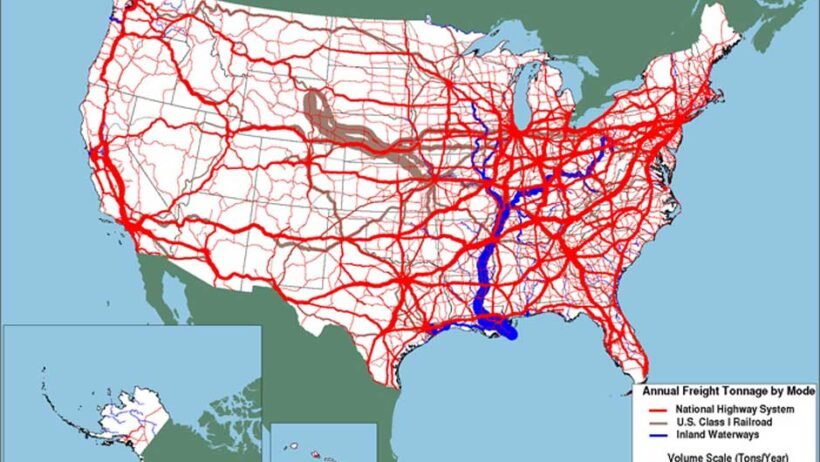

Freight movement is the hidden engine of the American economy. Every ton of cargo that moves along highways, rails, rivers, or ports represents industrial output, consumer demand, and logistical precision. Among fifty states, a handful dominate this movement.
Ranking them by total freight tonnage — not by dollar value — reveals which states truly carry the physical weight of the nation’s commerce. These are the places where infrastructure meets geography and industry to keep America supplied, connected, and moving.
How the Ranking Was Determined
This list is based on the U.S. Department of Transportation’s Freight Analysis Framework and recent state freight plans. The ranking reflects total tons of freight handled across all modes — trucking, rail, water, air, and pipeline. Trucks carry roughly two-thirds of the nation’s freight tonnage, underscoring why states with strong highway networks define the geography of commerce.Tonnage, rather than monetary value, best represents the logistical and infrastructural burden on a state’s transport network. It highlights where physical movement — and therefore freight congestion, wear, and opportunity is the greatest.
Texas
Texas ranks first with more than two billion tons of freight moved each year. Its size, energy production, and cross-border trade with Mexico make it the nation’s freight giant. Interstates link the Gulf Coast, Midwest, and Southwest, forming an extensive trucking grid.
The state’s role is both origin and transit: crude, chemicals, manufacturing, and agricultural goods all move through its highways and rail lines. Texas demonstrates how vast geography, energy output, and trade access translate directly into freight dominance.
California
California follows as the leading coastal freight state. Its ports handle an enormous share of imports and exports, feeding inland markets across the country. High population density and strong manufacturing add to internal freight volume.
Trucking and intermodal routes radiate from the coast toward the interior, turning California into both a gateway and generator of freight flows. Despite congestion and regulation challenges, it remains indispensable to national and international supply chains.
Illinois
Illinois serves as America’s central interchange. The convergence of major rail lines and interstate highways around Chicago makes it a national pivot for freight of every type. Nearly all east–west and north–south routes pass through or near the state.
Manufacturing and warehousing strengthen its internal freight demand, while its location ensures steady transit traffic. Illinois embodies how strategic centrality can rival coastal advantage in total tonnage.
Ohio
Ohio’s economy is rooted in manufacturing, distribution, and logistics. Positioned between the Great Lakes and the Atlantic corridor, it connects the Midwest to the East Coast. Its highway network and intermodal facilities handle nearly a billion tons of freight annually.
Automotive parts, steel, chemicals, and consumer goods move through Ohio daily. Its infrastructure makes it one of the most balanced freight states — heavy industry, through-traffic, and final-mile distribution all contribute.
Indiana
Indiana ranks fifth nationally, about one-third of that volume simply passes through, illustrating its role as a national corridor rather than just a point of origin. Interstates 65, 70, 74, 80, and 90 form a dense web linking the Great Lakes, Midwest, and eastern markets — earning Indiana its title as the Crossroads of America.
As freight volumes rise, so does the complexity of accident liability. In such cases, contacting an Indiana truck accident attorney may become necessary. Freight flow through Indiana is projected to grow by more than 60 percent by 2040, confirming its position as one of the country’s most vital arteries of commerce.
Georgia
Georgia anchors the Southeast’s freight system. A combination of port access, extensive highways, and growing distribution centers make it a regional hub. Freight from international imports, southern manufacturing, and agricultural exports all converge there.
Georgia’s infrastructure strategy continues to attract logistics investment and solidify its top-ten standing.
Michigan
Michigan’s freight strength comes from manufacturing and international trade with Canada. Automotive supply chains and industrial output generate large internal movements, while the border crossings handle a steady flow of goods between two nations.
The state’s waterborne freight and proximity to Great Lakes shipping complement its road and rail volume.
Florida
Florida’s freight activity is driven by population growth, tourism supply, and trade through Atlantic and Gulf ports.
Heavy inbound freight supports its consumer markets, while agricultural exports move outbound. Its extensive highway network manages continuous truck flow serving urban and coastal regions.
Pennsylvania
Pennsylvania links the Midwest to the Northeast. Its central location in the eastern corridor, dense population, and legacy manufacturing create consistent freight demand.
The state’s interstates and railways carry heavy through-traffic, while regional distribution centers serve major metropolitan areas from Philadelphia to Pittsburgh.
New York
New York completes the top ten with high-density freight tied to its metropolitan market and international gateways. Ports, airports, and highways collectively manage enormous inbound shipments to feed one of the world’s largest consumer regions.
Despite space and congestion constraints, its logistical reach keeps it among the nation’s busiest freight states.
Patterns and Implications
The leading freight states share key traits: advantageous geography, robust infrastructure, and diversified economies. Central states like Illinois and Indiana dominate through-freight; border and coastal states like Texas and California lead in imports and exports. Together they outline the backbone of U.S. commerce.
For trucking companies, these corridors mean constant demand but also higher traffic density and operational pressure. For logistics planners, they identify ideal regions for distribution hubs and intermodal terminals. For policymakers, they highlight where infrastructure investment yields national benefits.
Looking Ahead
Freight volumes will continue to rise across all ten states. Growth in e-commerce, population shifts, and near-shoring of manufacturing will intensify demand on existing networks. The Federal Highway Administration projects that U.S. freight tonnage will increase at an average rate of about 1.6 % per year between 2023 and 2050, with truck tonnage growing faster than other modes.
States like Indiana and Georgia, which combine space for expansion with strategic placement, may see the sharpest gains. The challenge ahead lies in modernizing highways, integrating smart-logistics systems, and maintaining safety as freight density increases.
Conclusion
Freight leadership is not only about economic scale — it reflects how geography, infrastructure, and industry align to move the nation’s goods efficiently. From the energy corridors of Texas to the interstates of Indiana, these ten states carry the bulk of America’s physical economy.
Their highways, rails, and ports form a continuous system that sustains growth and connection. Understanding where and why freight moves most reveals the true structure of the country’s commerce — one built on motion, precision, and the steady rhythm of logistics.